

Scientists Detect Powerful Wind From Milky Way's Central Supermassive Black Hole, Solving 50-Year Mystery
Astronomers have made a groundbreaking discovery by detecting, for the first time, a powerful stream of gas or "wind" emerging from Sagittarius A* (Sgr A*), the supermassive black hole at the center of the Milky Way galaxy.

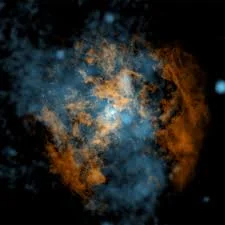
Landmark Discovery Reveals Sagittarius A* Is Blowing High-Speed Gas Across the Heart of Our Galaxy
Washington: Astronomers have made a groundbreaking discovery by detecting, for the first time, a powerful stream of gas or "wind" emerging from Sagittarius A* (Sgr A*), the supermassive black hole at the center of the Milky Way galaxy.
The finding provides the first direct observational evidence of a phenomenon that astrophysicists have predicted for decades and helps solve a scientific mystery that has persisted since the 1970s.
The research, published in The Astrophysical Journal Letters, offers new insights into how black holes interact with their surrounding environments and influence the evolution of galaxies.
First Direct Evidence of a Black Hole Wind
For more than 50 years, scientists believed that matter spiraling toward a supermassive black hole should generate powerful outflows, jets, and winds as it accelerates to extremely high speeds.
While theoretical models strongly supported this idea, astronomers had never been able to directly observe such a wind emerging from Sagittarius A*, the black hole located at the center of our own galaxy.
The new study has now provided the clearest evidence yet that even a relatively quiet black hole can continuously push material outward into surrounding space.
Researchers say the discovery confirms a key prediction of modern astrophysics.
How Scientists Made the Discovery
The international research team analyzed five years of observations collected by the Atacama Large Millimeter/submillimeter Array (ALMA) in Chile, one of the world's most advanced radio astronomy observatories.
Using highly detailed imaging techniques, scientists mapped the cold molecular gas surrounding Sagittarius A* with unprecedented precision.
After filtering out intense radio emissions from the black hole itself, researchers identified a remarkable cone-shaped cavity extending approximately three light-years through a nearby gas cloud.
The unusual structure immediately attracted attention because it appeared to have been carved out by a powerful force.
NASA Data Confirmed the Presence of High-Speed Gas
To verify their findings, scientists compared the ALMA observations with data from NASA's Chandra X-ray Observatory.
The X-ray observations revealed that the cavity was filled with extremely hot gas moving outward at thousands of kilometers per second.
Researchers concluded that the expanding gas is being driven by a wind originating from Sagittarius A*.
The discovery represents the strongest evidence to date that the Milky Way's central black hole actively interacts with its surroundings despite currently being in a relatively dormant state.
Wind May Have Been Blowing for Thousands of Years
According to the study, the black hole wind may have been continuously shaping the galactic environment for at least 20,000 years.
Although Sagittarius A* is currently classified as a quiet or inactive supermassive black hole, the findings suggest it still exerts a significant influence on nearby gas clouds and interstellar matter.
Scientists believe the wind's direction may shift over time, gradually affecting different regions around the galactic center.
The discovery challenges previous assumptions that only highly active black holes produce significant outflows.
Why Observing the Milky Way's Black Hole Is So Difficult
Studying Sagittarius A* presents unique challenges for astronomers because Earth is located within the Milky Way itself.
Unlike distant galaxies that can be observed from the outside, researchers must look through vast amounts of gas, dust, and energetic material to study the center of our own galaxy.
These obstacles often block or distort observations, making it extremely difficult to identify subtle structures around the black hole.
Advances in radio astronomy and high-resolution imaging technology were critical in enabling scientists to make this breakthrough observation.
New Insights Into Black Hole Behavior
Researchers say the findings could significantly improve understanding of how black holes influence star formation, gas movement, and galaxy evolution.
Even though Sagittarius A* is relatively inactive compared to some of the universe's most energetic black holes, the newly detected wind demonstrates that dormant black holes can still play an important role in shaping their surroundings.
The discovery provides astronomers with a rare opportunity to study black hole feedback processes close to home.
Because Sagittarius A* is the nearest supermassive black hole to Earth, it serves as an important natural laboratory for understanding similar phenomena throughout the universe.
What This Means for Future Astronomy Research
The detection of a wind emerging from Sagittarius A* opens new possibilities for studying the relationship between black holes and galaxies.
Scientists believe the findings will help improve models of:
- Black hole growth
- Galactic evolution
- Star formation processes
- Gas dynamics in galaxies
- Energy transfer in cosmic environments
Researchers also hope that future observations using next-generation telescopes and observatories will reveal additional details about the structure, strength, and long-term impact of the newly discovered outflow.
A Major Milestone in Understanding the Universe
The discovery marks one of the most significant breakthroughs in black hole research in recent years.
By finally identifying the elusive wind predicted by astrophysical theories for decades, scientists have gained a clearer understanding of how even quiet supermassive black holes continue to shape the galaxies they inhabit.
As astronomers continue to explore the center of the Milky Way, Sagittarius A* is expected to provide valuable clues about the hidden forces driving the evolution of galaxies across the cosmos.
(With inputs from agencies)






Comments (0)