

“Manipulation” Is the New FAANG? Deepak Bhatia Decodes the New Tech-Stock Acronym Making Waves on Social Media
From FAANG and MAANG to MANGO and now “MANIPULATION,” a new social-media-driven concept is putting a fresh group of technology companies at the centre of the market conversation.

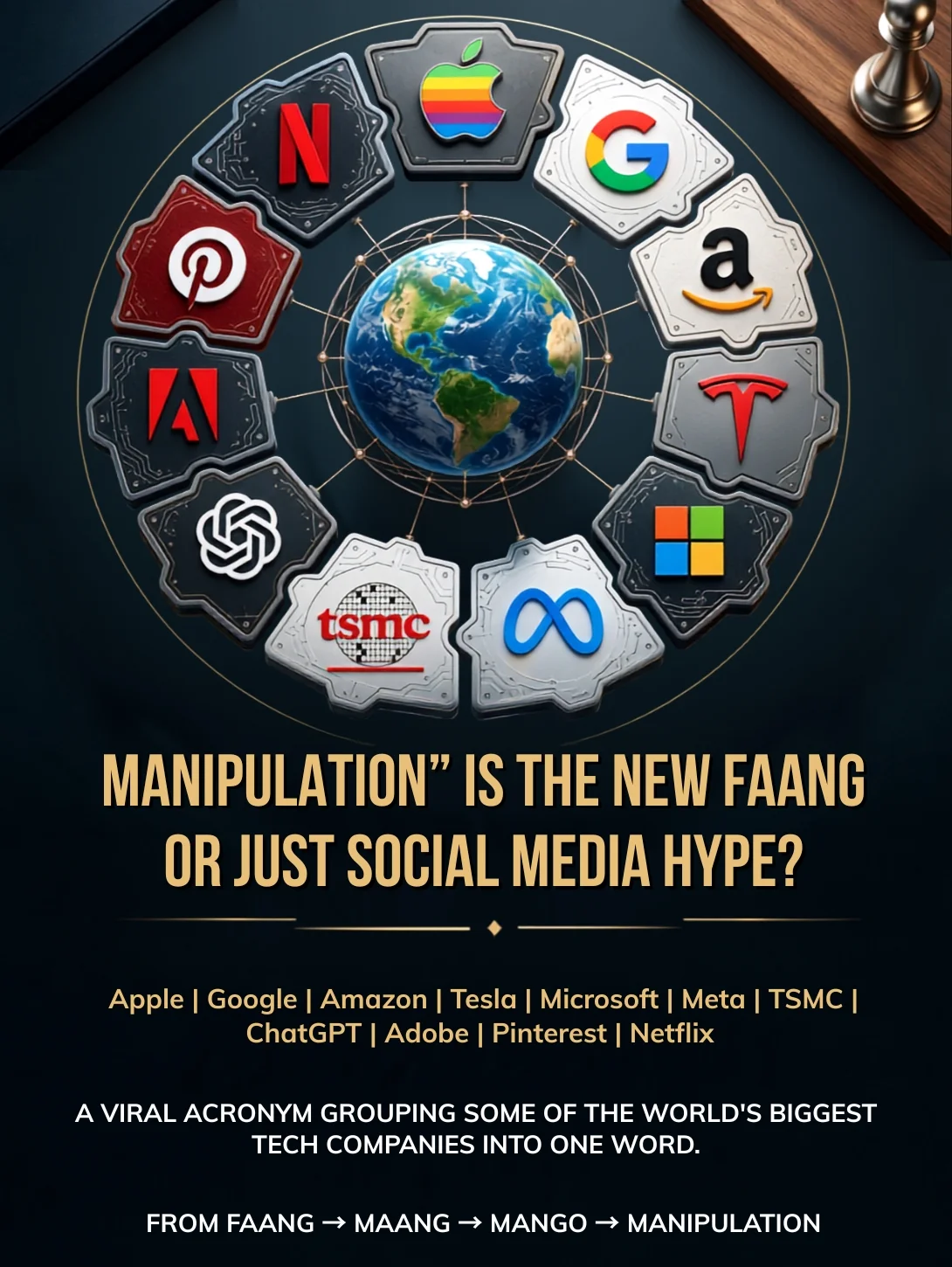
From FAANG and MAANG to MANGO and now “MANIPULATION,” a new social-media-driven concept is putting a fresh group of technology companies at the centre of the market conversation.
The technology and stock-market landscape has always had a fascination with memorable acronyms.
For years, FAANG became one of the most recognisable terms associated with leading technology stocks — Facebook, Amazon, Apple, Netflix and Google. Beyond being a convenient abbreviation, FAANG came to represent a generation of companies that played a defining role in the growth of the digital economy.
As technology continues to evolve, however, the conversation around the companies shaping the next cycle is changing as well.
From FAANG to MAANG, and more recently MANGO, social media has increasingly become a platform for creating new ways to group and discuss influential technology companies.
Now, another acronym is attracting attention:

MANIPULATION
The concept groups together 12 prominent companies from different areas of the technology and digital economy:
M — Meta
A — Anthropic
N — Nvidia
I — Intel
P — Palantir
U — Uber
L — LinkedIn
A — Apple
T — Tesla
I — IBM
O — OpenAI
N — Netflix
It is important to note that MANIPULATION is a social-media-driven concept, not an official stock-market index, investment category or recognised financial classification.
Yet its emergence raises an interesting question: Could this be the next way people talk about the technology companies shaping the market?
Deepak Bhatia on the Rise of New Tech-Stock Narratives
Digital strategist and entrepreneur Deepak Bhatia believes the popularity of these acronyms reflects the changing way people discover and discuss technology companies.
According to Bhatia, the significance of the trend goes beyond the acronym itself. It highlights how quickly market narratives can now emerge and gain attention through social platforms.
“The interesting part is not simply the acronym. It is what these new groupings tell us about how the technology landscape is changing. FAANG represented one generation of technology leaders, while today's conversations are increasingly shaped by artificial intelligence, semiconductors, data and emerging digital platforms.”
The companies included in MANIPULATION operate across very different industries.
Nvidia is closely associated with the infrastructure powering the AI boom. OpenAI and Anthropic represent the rapidly developing generative-AI sector. Meta, Apple and Netflix are major players in consumer technology and digital experiences, while Tesla operates across automobiles, energy and technology.
At the same time, Intel and IBM represent established technology and computing businesses, while Palantir, Uber and LinkedIn occupy distinct positions within software, digital platforms and professional technology.
Bringing such diverse companies together under one acronym inevitably creates discussion.
And that discussion may be part of the reason the concept has attracted attention online.
From FAANG to MANIPULATION: A Changing Technology Landscape
The rise of FAANG coincided with an era defined by the expansion of social networks, search, e-commerce, digital advertising and streaming.
Today's technology cycle is increasingly being shaped by artificial intelligence, advanced semiconductors, cloud infrastructure, data and automation.
As a result, the boundaries between traditional technology categories are becoming less clear.
A semiconductor company can become central to the AI ecosystem.
An AI company can become a major technology platform.
An automobile company can increasingly be viewed through the lens of software and artificial intelligence.
This changing landscape makes it difficult to define today's technology leaders using the same framework that was used a decade ago.
That is where new acronyms such as MANGO and MANIPULATION enter the conversation.
They represent attempts to answer a simple question:
Which companies could define the next era of technology?
Deepak Bhatia: “Market Narratives Are Moving Faster Than Ever”
One of the biggest changes in today's investment environment is the speed at which information travels.
Social media allows market-related ideas, company comparisons and technology trends to reach large audiences almost instantly.
Bhatia believes this has changed the way people engage with market narratives.
“The speed of information has completely changed the conversation. A market narrative can now emerge on social media and reach a large audience very quickly. That makes it easier for people to discover new companies and trends, but it also makes it important to look beyond the headline and understand the fundamentals.”
This distinction is particularly relevant when discussing acronym-based market narratives.
A memorable label can make a group of companies easier to understand and discuss. But companies within the same acronym can have very different business models, valuations, financial performance and growth prospects.
An acronym can create a conversation, but it cannot replace independent analysis.
Why the MANIPULATION Acronym Is Generating Debate
The appeal of MANIPULATION lies partly in its simplicity.
Twelve companies with very different businesses are brought together under one memorable word.
That makes the concept easy to recognise, discuss and share.
At the same time, it naturally invites questions.
Why these companies?
Why not others?
What common characteristic connects them?
And does being included in a viral acronym actually say anything meaningful about their long-term market position?
These questions are important because social-media popularity and financial significance are not necessarily the same thing.
The acronym may generate attention, but investors and market observers still need to evaluate each company on its own merits.
Is “MANIPULATION” Really the New FAANG?
It is too early to say.
FAANG became deeply established in technology and financial conversations because the companies associated with it collectively represented an important phase of the digital economy.
MANIPULATION is currently better understood as a new social-media-driven way of grouping prominent technology companies, rather than an established successor to FAANG.
Whether it becomes a lasting market term or simply another short-lived internet trend remains to be seen.
But the conversation itself is revealing.
The definition of Big Tech is changing.
The companies that could influence the next decade of technology may not be identical to those that dominated the previous one.
Artificial intelligence has introduced new players, strengthened the strategic importance of computing infrastructure and changed expectations around established technology businesses.
As these developments continue, the search for the “next FAANG” is likely to continue as well.
Deepak Bhatia’s Perspective: The Acronym May Change, but the Market Is Evolving
For Bhatia, the real value of the MANIPULATION conversation lies in what it reveals about the broader technology ecosystem.
“Every acronym is ultimately an attempt to simplify a much larger story. The important thing is not whether one particular acronym becomes permanent. What matters is understanding which companies, technologies and business models are actually shaping the next cycle.”
That perspective places the focus back where it belongs — on the underlying technology and businesses rather than simply the popularity of a label.
FAANG gave the previous technology cycle a name.
Today's market is still searching for the language that best describes what comes next.
FAANG → MAANG → MANGO → MANIPULATION
Whether MANIPULATION becomes a lasting part of technology and market vocabulary is still an open question.
But its emergence demonstrates how quickly social media can turn a collection of companies into a recognizable market narrative.
For investors, technology enthusiasts and businesses alike, the bigger story is not necessarily the acronym.
It is the rapid transformation of the technology landscape itself.
And as artificial intelligence continues to reshape markets, products and companies, one thing seems certain:
The conversation around the next generation of technology leaders is only getting started.











Comments (0)