

Indian-American Voters Shift Towards Democrats: H-1B Restrictions, Racism and Immigration Policies Shape Midterm Choices
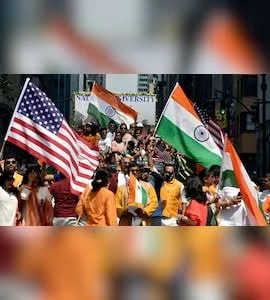
Concerns over immigration restrictions, racism and the Trump administration's approach towards immigrants appear to have influenced the political preferences of Indian-Americans ahead of the 2026 US midterm elections. A pre-election survey by the Carnegie Endowment for International Peace found a significant preference for Democratic candidates among Indian-American respondents.
According to the survey, 62% of respondents intended to vote for Democrats, compared with 19% who planned to support Republicans. Another 12% remained undecided.
The findings point towards a challenging political environment for Republicans among Indian-American voters, a community that has traditionally shown stronger support for the Democratic Party.
Conducted in partnership with YouGov between October 7 and 27, the survey covered 1,000 Indian-American adults. Its findings offer insight into how immigration debates, experiences of discrimination and political developments under President Donald Trump are shaping the community's voting preferences.
Republican Support Declines Among Indian-American Men
The survey highlighted a notable decline in Republican support among Indian-American men, particularly those aged 40 and above.
Only 16% of men in this age group said they intended to vote Republican, compared with 32% in January 2026.
The decline was also visible among younger Indian-American men. Among respondents aged 18 to 39, Republican support stood at 23%, compared with the 40% support Donald Trump reportedly received from this group in 2024.
The broader political identification figures also reflected a preference for Democrats. Around 46% of respondents identified as Democrats, while 19% described themselves as Republicans. Approximately 26% identified as independents.
Interestingly, not all respondents planning to vote for Democrats said they were motivated by support for the party.
Around 35% said their preference was primarily driven by opposition to the Republican candidate or party. The remaining 65% said they intended to vote Democrat because they supported the party or its candidate.
This distinction suggests that dissatisfaction with Republican policies and candidates may be an important factor alongside positive support for Democratic positions.
H-1B Visa Restrictions and Deportation Policies Raise Concerns
Immigration policy has emerged as a significant issue influencing the political outlook of Indian-Americans.
Many members of the community work in technology, healthcare, research and other professional sectors that rely on international talent mobility. Consequently, changes to H-1B visa rules and broader immigration enforcement policies can have direct implications for their careers and families.
Concerns have grown over restrictions affecting skilled foreign workers, deportations and increased scrutiny of Indian technology companies.
Trump has repeatedly taken a hard-line position on immigration. However, critics argue that political messaging around immigration does not always clearly distinguish between undocumented migrants and foreign nationals who legally live and work in the United States.
For Indian-American professionals, uncertainty surrounding work visas, employment opportunities and immigration procedures can create concerns about long-term stability.
These issues may be contributing to the decline in Republican support reflected in the Carnegie survey.
Nearly Half of Indian-Americans Report Seeing Racist Content Online
Experiences of discrimination are another factor highlighted by the survey.
According to the findings, 48% of respondents said they encountered racist social media posts targeting Indians or Indian-Americans somewhat or very often. Around 25% said they had personally been called a racial slur.
Several controversies in recent months have brought these concerns into public discussion.
In September 2026, the US Department of Homeland Security reportedly shared an image showing a Transformers character confronting a Sikh man. The post carried the caption, "America for Americans. Get off our roads. You don't know how to drive Mr. Singh".
The post referred to a truck crash involving an Indian driver and attracted criticism over its portrayal of the Sikh community. It was subsequently deleted.
Another incident occurred in October, when authorities arrested a 19-year-old in Illinois over an alleged plan to carry out a mass shooting at the Sri Venkateswara Swami Temple near Chicago.
The case added to concerns about the safety of Indian-American religious and cultural institutions. However, the alleged plot should be distinguished from an established attack, as the reported incident involved an arrest and investigation.
A separate controversy involved Bo French, a Republican candidate for Texas Railroad Commissioner. He shared a photograph of University of Texas students of South Asian origin celebrating a football victory and claimed that the image demonstrated how Americans had been "displaced by foreigners".
The post drew criticism from both Democratic and Republican figures. French later said his comments were directed at immigration policies rather than any particular community.
Together, these incidents have contributed to wider discussions about racial prejudice, online hostility and the treatment of Indian-Americans in the United States.
Why the Indian-American Vote Matters in US Elections
Although Indian-Americans account for approximately 1.5% of the US population, their political influence extends beyond their numerical share.
Around 5.2 million people in the United States identified as Indian in 2023. The community has also recorded relatively high voter participation in recent presidential elections.
According to the figures cited in the survey report, Indian-American voter turnout stood at approximately 71% in 2020 and 70% in 2024.
Their economic influence is another reason political parties pay attention to the community. Indian-American households have one of the highest median incomes among major ethnic groups in the country, with the median reportedly exceeding twice the national level.
The community also contributes significantly to the US economy through employment, entrepreneurship, business ownership and tax payments. The supplied report estimates that Indian-Americans contribute around 5% to 6% of the country's income tax revenue, amounting to approximately $250 billion to $300 billion.
These figures, alongside strong voter participation, make Indian-Americans an important constituency for candidates seeking support in competitive electoral contests.
Indian-American Voters Could Influence Key Battleground States
The geographical distribution of Indian-American voters also adds to their political importance.
Nearly half of the community lives in California, Texas, New Jersey and New York. However, sizeable Indian-American populations are also present in suburban areas of politically competitive states.
Georgia, Michigan, Pennsylvania and North Carolina are among the states where their votes could matter in closely contested races.
In elections decided by narrow margins, even a relatively small shift in voting preferences among a politically engaged community can become significant.
For both Democrats and Republicans, understanding the concerns of Indian-American voters may therefore be important beyond the immediate midterm contest.
Conclusion
The Carnegie Endowment survey suggests that immigration restrictions, concerns over racism and dissatisfaction with aspects of the Trump administration's policies are influencing Indian-American voting preferences ahead of the 2026 US midterm elections.
With 62% of respondents indicating support for Democrats and Republican backing declining among Indian-American men, the findings point towards a changing political mood within the community.
However, the survey also shows that voting decisions are not driven by a single issue. Party preference, opposition to candidates, immigration concerns and personal experiences of discrimination all contribute to political choices.
As Indian-Americans continue to play an increasingly visible role in the country's economic and political landscape, their voting preferences could become an important factor in future US elections.
Sources By Agencies

Startup Tribune Team is the editorial team behind Startup Tribune, covering startups, business, entrepreneurship, technology, funding and innovation. The team publishes news, company updates and industry insights to keep readers informed about the latest business developments through clear, relevant and responsibly sourced content.


Comments (0)