

Udta Teer Movie Review: Ayushmann Khurrana Leads an Uneven Spy Comedy That Misses Its Target
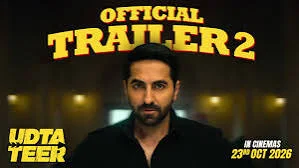
Udta Teer attempts to turn the familiar world of espionage into a comedy of errors, placing Ayushmann Khurrana at the centre of a story about mistaken identity, lost memories and a secret mission that spirals out of control. While the premise offers plenty of opportunities for humour, the film struggles to turn its unusual setup into a consistently entertaining experience.
Directed by Akash A. Kaushik, the film follows a Pakistani intelligence operative who suffers a serious head injury and loses his memory while operating in India. Unable to remember his real identity or mission, he begins to believe he is an Indian counter-terrorism officer. The confusion leaves his handlers scrambling to contain the situation.
The concept invites comparisons with international spy spoofs such as Austin Powers, but Udta Teer does not always manage the balance between absurdity, satire and storytelling that makes the genre work. It has flashes of comic energy and a committed central performance, yet its humour and narrative frequently lose direction.
Udta Teer Plot: A Secret Agent Who Forgets His Mission
The story revolves around Bilal Ahmed, a Pakistani spy operating undercover in India as Vikrant Thapar. His cover is strengthened by his marriage to Yamini, played by Sara Ali Khan, who works in the finance department of India's defence ministry.
Bilal's mission takes an unexpected turn after he sustains a serious head injury and loses his memory. He can no longer recall his identity, his handlers or the purpose of his assignment. Instead, he starts seeing himself as an Indian operative determined to fight terrorism.
The sudden change creates a crisis for his superiors, General Mir and Niyazi, who must find a way to manage an agent who no longer understands which side he belongs to. Meanwhile, Bilal's actions become increasingly unpredictable, putting the larger operation at risk.
The premise has the ingredients for an entertaining spy comedy. However, the film's shift from espionage drama to broad farce does not always feel controlled, leaving several potentially funny situations underdeveloped.
Ayushmann Khurrana Anchors the Film
Ayushmann Khurrana is the film's most consistent strength. Known for taking on characters who challenge familiar Bollywood hero stereotypes, he plays Bilal as a man caught between conflicting identities and an increasingly unreliable understanding of reality.
His performance helps maintain the film's momentum even when the screenplay becomes scattered. Rather than presenting Bilal as a conventional action hero, Khurrana leans into the character's confusion and unpredictability.
This approach suits the actor's established screen persona, which often draws humour from ordinary people finding themselves in extraordinary circumstances. Here, the comic possibilities are broader, but Khurrana remains committed to the film's eccentric tone.
His work gives the story a central point of focus, even when the writing struggles to provide a clear direction.
Sara Ali Khan Has Limited Scope
Sara Ali Khan plays Yamini, Bilal's wife, whose connection to India's defence establishment is an important part of the undercover operation.
Despite the character's relevance to the premise, Yamini is largely positioned around the male protagonist's journey. Her role offers limited room for independent development, making her presence feel more functional than substantial.
The story could have benefited from giving Yamini greater agency, particularly because her professional position and personal relationship with Bilal place her at the intersection of the film's domestic and espionage storylines.
Supporting Cast Adds to the Comic Chaos
The supporting performances help sustain the film's deliberately exaggerated atmosphere.
Gulshan Grover plays General Mir, while Ram Kapoor appears as Niyazi. Their characters are forced to respond to the increasingly chaotic consequences of Bilal's memory loss. Both actors lean into the absurdity of the situation, contributing to the film's broad comic style.
Mukul Dev also features as a bumbling terrorist involved in planning attacks that repeatedly threaten to backfire. The film marks his final screen appearance, adding significance to his performance.
Suhail Nayyar plays one of Bilal's associates, who struggles to make sense of the agent's erratic behaviour. Smita Tambe and Rahul Bose appear as senior intelligence officials, working within the opportunities their roles provide.
The ensemble is generally willing to embrace the film's exaggerated premise. However, energetic performances cannot always compensate for inconsistent writing.
Does Udta Teer Succeed as a Spy Spoof?
The film's central challenge is its attempt to parody espionage while retaining the framework of a conventional spy thriller.
A memory-loss plot can create comic misunderstandings, unexpected alliances and situations in which a trained operative becomes his own worst enemy. Udta Teer explores these possibilities, but its humour does not land consistently.
Some scenes benefit from the sheer absurdity of Bilal's predicament. Others rely on exaggerated reactions or dialogue that feels more awkward than amusing. The film often moves forward without allowing its strongest comic ideas enough time to develop.
The result is a spy spoof with occasional entertaining moments but limited sustained hilarity. It is neither consistently sharp enough to work as satire nor tightly constructed enough to deliver the impact of a conventional espionage thriller.
Political Satire and Sensitive Identity-Based Humour
Because Udta Teer centres on a Pakistani operative working undercover in India, its story naturally draws on questions of national identity, intelligence agencies and cross-border tensions.
However, one exchange involving language and religious identity risks undermining the film's comic intent. A character questions how Bilal, now believing himself to be Vikrant, can read Urdu if he is Hindu. The remark relies on an incorrect assumption about the relationship between religion and language.
Urdu is not exclusive to any one religious community, and using such a misconception as a punchline can come across as uninformed rather than funny.
For a film that seeks to make light of espionage and national-security narratives, sharper writing could have produced more effective satire without depending on simplistic identity-based assumptions.
Direction and Screenplay: Where the Film Loses Momentum
Udta Teer marks Akash A. Kaushik's feature directorial debut. His previous writing credits include Housefull 4 and Bhool Bhulaiyaa 2 and Bhool Bhulaiyaa 3.
The film's premise suggests a fast-moving comedy in which every mistaken decision creates another complication. Yet its execution often feels less precise than the concept demands.
The screenplay jumps between spy intrigue, domestic comedy and broad farce without always establishing a satisfying rhythm. Several sequences appear designed to keep the chaos going rather than deepen the characters or build towards a stronger payoff.
The film does maintain a degree of forward movement, and its performers largely understand the exaggerated world they inhabit. Nevertheless, stronger narrative discipline and more carefully developed jokes could have made the experience considerably more rewarding.
Udta Teer vs Dhurandhar and Austin Powers
The film's approach stands in contrast to the more serious treatment of espionage associated with Dhurandhar. Rather than pursuing a grounded, intense spy narrative, Udta Teer attempts to find comedy in a world of secret missions, intelligence officers and shifting loyalties.
Its other obvious point of comparison is Austin Powers, the Hollywood franchise known for sending up spy-film conventions through exaggerated characters and deliberately ridiculous situations.
However, invoking a successful parody creates a high bar. Effective spoof comedy requires more than an outrageous premise; it also needs precise timing, memorable characters and an understanding of the genre being mocked.
Udta Teer occasionally captures the spirit of irreverent spy comedy, but it lacks the consistency needed to make its absurdity truly memorable.
Udta Teer Review Verdict: Watch It With Modest Expectations
Udta Teer has a promising central idea and a lead actor capable of making unusual characters engaging. Ayushmann Khurrana brings commitment to the role of a spy who has lost both his memory and his sense of identity, while the supporting cast adds energy to the film's chaotic situations.
However, uneven humour, underdeveloped characters and an unfocused screenplay prevent the film from fully realising its potential. The comedy produces occasional amusement rather than the sustained laughter that a spy spoof of this kind requires.
Viewers who enjoy absurd premises and are willing to overlook inconsistent storytelling may find a few entertaining moments. Those expecting a tightly written satire or a genuinely hilarious alternative to conventional spy thrillers may leave disappointed.
Sources By Agencies

Startup Tribune Team is the editorial team behind Startup Tribune, covering startups, business, entrepreneurship, technology, funding and innovation. The team publishes news, company updates and industry insights to keep readers informed about the latest business developments through clear, relevant and responsibly sourced content.




Comments (0)